28 Sep 26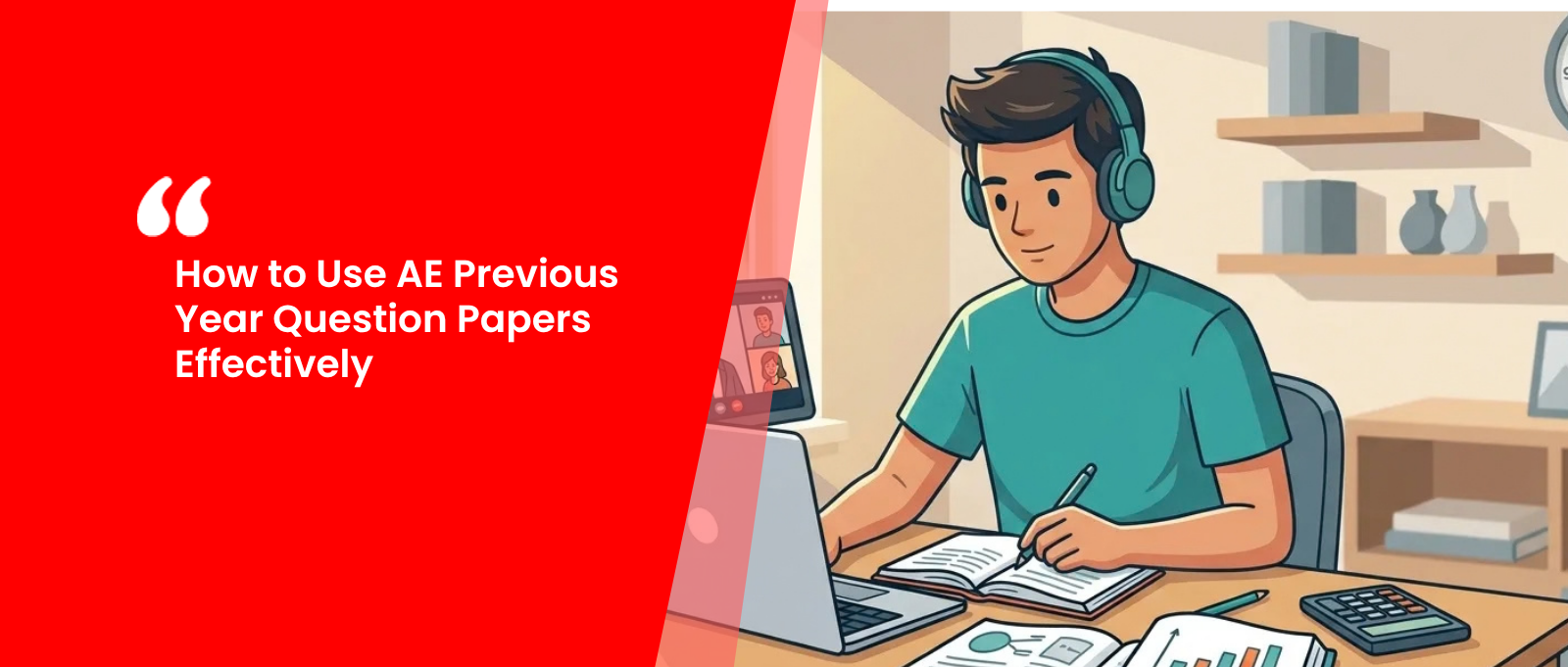
Every serious AE aspirant in Kerala knows that previous year question papers matter. Most, however, use them wrong. They solve a paper, check the marks, and move on. That approach wastes the most valuable material you have. Used with a method, AE previous year question papers by one of the top GATE coaching centers in Kerala reveal the pattern, the weightage, and the mistakes that cost you a rank.
If you are just starting, read The Complete Roadmap to Becoming an Assistant Engineer in Kerala first. It explains eligibility, the syllabus, and the selection process. This guide adds the practice half: how to turn those papers into marks.
Why AE Previous Year Question Papers Matter
Past papers do four things for you. First, they show the real exam pattern. The selection process and exam pattern depend on the specific Kerala PSC AE notification. Before practising, check the latest notification for your post, including the number of questions, duration, marks, and negative-marking rules, and the paper you practise on should look exactly like the one you will face. Second, they reveal weightage: some topics appear every year, while others show up once a decade, and that distribution tells you where to spend your study hours. Third, they teach question style, because you learn how the board takes a familiar concept and twists it into an exam question, a skill no textbook alone gives you. Fourth, they build speed, since under time pressure a practised hand thinks faster than a well-read one.
Solve AE Previous Year Question Papers Topic-Wise First
Most beginners make one error: they attempt full papers before the syllabus is covered. Instead, pick one subject, say, electrical machines for an Electrical AE post, and solve every question on it from the last eight to ten papers.
Topic-wise solving builds confidence in one area at a time, because every correct answer on a subject you have studied reinforces what you know. It also shows you exactly how each concept is asked; the same machine-design principle that takes a page in a textbook becomes a one-line question in the exam. And it leaves a clear record of weak topics: if you keep slipping on the same unit, the pattern becomes visible within a few papers instead of staying buried inside a full test. Once three or four core subjects are covered topic-wise, move to full papers.
Analyse, Don’t Just Solve
Solving is half the work. Analysis is the other half. After every paper, go through each wrong answer and ask yourself why it went wrong. Was it a concept gap you have not studied yet? A calculation slip that a second read would have caught? A misread question, where you answered what the paper seemed to ask rather than what it actually asked? Or a time-pressure mistake, where you rushed a question you could have solved calmly? Each cause needs a different fix, and naming the cause is what turns a wrong answer into a lesson.
Mark questions that repeat across years. They signal high-weightage topics. A good rule: spend two hours solving and one hour analysing. That one hour decides how much the paper teaches you.
Practise Full Papers Under Exam Conditions
Once your topic-wise practice is solid, take full papers as mock tests. Sit for the full duration without any break; Set the mock-test duration according to the latest Kerala PSC notification for your AE post. Follow the exact number of questions, marks, duration, and negative-marking rules mentioned in the notification. Keep the hall conditions honest: no phone, no notes, no interruptions, and write your answers on an OMR-style sheet so that filling bubbles becomes as automatic as solving. Follow the negative marking given in your notification too, because most Kerala PSC exams deduct marks for wrong answers, and a practice score that ignores that penalty flatters your real performance.
Check your answers only after the timer ends. This mirrors the real hall, where the clock is your only judge. For a structured timeline, our 3-month study plan for the Kerala PSC Assistant Engineer exam fits paper practice into each month.
Keep an Error Notebook
Maintain a separate notebook purely for mistakes. Record the concept gaps you must restudy, the formula slips you keep making, the repeated traps the paper setter lays for careless candidates, and even the questions you solved correctly but slowly, because a correct answer that eats two extra minutes is a rank risk in a timed exam. Review this notebook weekly. The notebook turns every paper into a personal study plan. Regularly reviewing your errors helps you turn repeated mistakes into targeted revision.
Where to Get AE Previous Year Question Papers
Use the official Kerala PSC website as your primary source for notifications, answer keys, and exam-related updates. Always match your practice papers with the latest notification for your specific AE post and engineering discipline.
If you are preparing for GATE alongside the AE exam, the same analysis method works for both; see our Tips to Crack the GATE Exam on Your First Attempt. For structured guidance, training at a GATE coaching center in Kerala gives you tested material, timed tests, and faculty who have studied these papers for years.
Common Mistakes to Avoid
- The most common mistake is solving only easy or old papers and skipping the recent ones, which leaves you unprepared for the current pattern.
- A second mistake is never timing yourself, so speed never becomes a trained skill.
- Another mistake is skipping the analysis after a paper and moving straight to the next one, which repeats the same errors instead of fixing them.
- Many aspirants also ignore negative marking while practising and discover the penalty only in the exam hall, and some solve papers before finishing the syllabus, which turns the paper from a diagnostic tool into a demoralising one.
None of these habits is fatal by itself, but together they explain why hard-working candidates underperform.
Conclusion
Previous papers are not a box to tick. They are a diagnostic tool. Solve topic-wise, analyse every mistake, practise under exam conditions, and revise from an error notebook. Done this way, AE previous year question papers become the most practical step in The Complete Roadmap to Becoming an Assistant Engineer in Kerala, the step where knowledge turns into marks. Start with the paper from your stream, and let it tell you what to study next.
Frequently Asked Questions
- How many years of AE question papers should I solve?
Aim to practise around eight to ten years of papers when available. Give particular attention to recent papers because they are more useful for understanding the current question style and difficulty level. Always prioritise papers relevant to your specific AE post and discipline.
- Are AE previous year question papers available with answers?
Kerala PSC publishes answer keys for many exams. Coaching materials and study groups also carry solved papers. Cross-check any unofficial solution against the official key.
- Should I solve AE papers topic-wise or as full papers?
Both, in that order. Start topic-wise to build coverage, then switch to full timed papers for exam readiness.
- Can solving AE papers help my GATE preparation?
Yes, on overlapping subjects like engineering mathematics and core branches. The question style differs, but the concepts reinforce each other.
- When should I start solving previous year papers?
Begin as soon as you have finished the syllabus of one core subject. Solving that subject’s questions topic-wise while the theory is fresh locks the concepts in, and full-paper practice can wait until most of the syllabus is covered.
- How many times should I revise a solved paper?
Once is enough for a first pass, but return to the questions you got wrong or solved slowly after two weeks. Re-solving your own errors is the highest-yield revision you can do.
 comments 0