23 Sep 26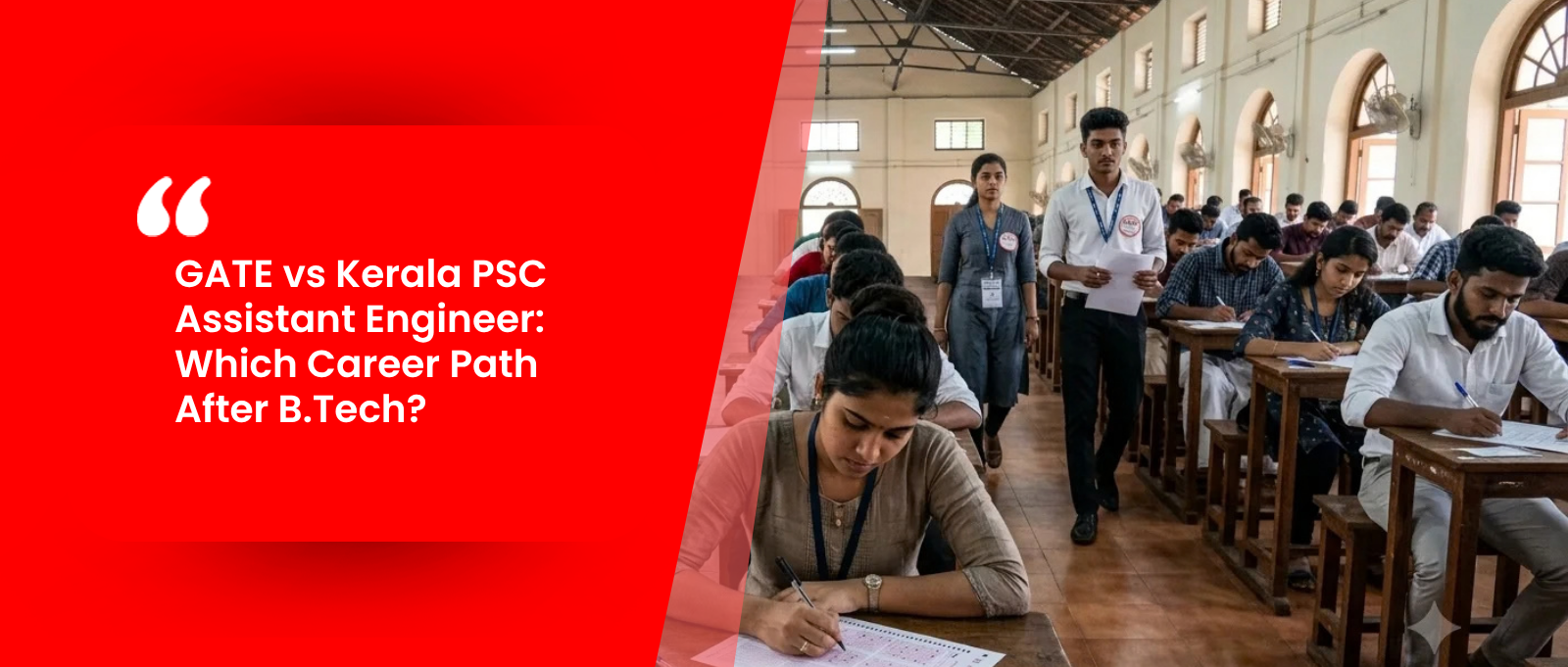
After completing a B.Tech in Electrical and Electronics Engineering, many students in Kerala consider GATE and Kerala PSC Assistant Engineer as potential career paths. Understanding the difference between GATE and Kerala PSC Assistant Engineer can help you evaluate the preparation requirements, career opportunities, and long-term options associated with each route.
If you are preparing for GATE Electrical Engineering, it is essential to build strong technical concepts, improve problem-solving skills, and perform well in the examination. At the same time, students interested in Kerala PSC Assistant Engineer recruitment need to understand the relevant syllabus, eligibility requirements, and selection process mentioned in the applicable notification.
This guide compares GATE and Kerala PSC Assistant Engineer after B.Tech, covering the exam pattern, subject-wise preparation strategy, study materials, career opportunities, and preparation approach. If you prefer structured guidance, joining a reputed GATE coaching center in Kerala can also support your preparation.
Quick Diagnosis
Do you want to pursue higher studies after B.Tech?
→ Consider focusing on GATE.
Are you primarily interested in engineering opportunities within Kerala government service?
→ Review the Kerala PSC Assistant Engineer route.
Do you want to keep both options open?
→ Build a strong technical foundation and prepare the additional exam-specific topics separately.
4. Are you still unsure about your career direction?
→ Compare the eligibility, syllabus, examination pattern, career opportunities, preparation time, and location preferences before choosing your primary preparation path.
GATE Exam Pattern for Electrical Engineering
Before you open your first textbook, you must understand the GATE exam pattern. Before preparing for GATE, check the official notification for the examination year you plan to attempt. Always confirm the paper pattern, eligibility requirements, important dates, and examination guidelines on the official GATE website. The paper is divided into three parts:
- General Aptitude: 15 marks (compulsory for all disciplines)
- Engineering Mathematics: Approximately 13 marks
- Electrical Engineering Core: Approximately 72 marks
The question types include Multiple Choice Questions (MCQs) with negative marking, Multiple Select Questions (MSQs) with no negative marking, and Numerical Answer Type (NAT) questions where you enter a calculated value directly.
Your GATE score is calculated out of 1000 and remains valid for three years from the date of announcement of results. GATE scores may also be considered by participating organizations for recruitment, depending on the organization, recruitment year, discipline, and eligibility requirements.
Subject-Wise Preparation Strategy
A disciplined subject plan is essential when you prepare for GATE Electrical Engineering. The Electrical Engineering syllabus covers ten sections, and each requires a different depth of attention:
- Electric Circuits: Network theorems, transient analysis, and three-phase circuits form the backbone. Solve problems daily.
- Electrical Machines: Start with transformers, DC machines, induction machines, and synchronous machines. Build the concepts first and then solve topic-wise previous-year questions. Maintain a formula sheet for frequently used equations and revise it regularly.
- Power Systems: Load flow, fault analysis, and stability concepts require conceptual clarity more than rote learning.
- Control Systems: Block diagrams, signal flow graphs, and compensators are high-weightage topics.
- Signals and Systems: Fourier and Laplace transforms appear in both theory and numerical problems.
- Analog and Digital Electronics: Semiconductor devices, op-amps, and combinational circuits need repeated revision.
- Power Electronics: Converters, choppers, and inverters are competitive differentiators for top ranks.
- Electromagnetic Fields: Often skipped by students, yet scoring if the basics are strong.
- Electrical and Electronic Measurements: Bridge circuits and instrument transformers are standard questions.
- Engineering Mathematics: Linear algebra, calculus, differential equations, probability, and complex variables are mandatory and scoring.
Students from Civil Engineering and Mechanical Engineering branches preparing for their respective GATE papers can adopt a similar tiered strategy: build core fundamentals first, then move to previous-year problem solving. If you are in your final year, begin serious preparation at least ten to twelve months before the exam.
12-Month GATE Electrical Engineering Preparation Plan
Months 1–4
- Core concepts
- Engineering Mathematics
- Network Theory
- Signals
- Basic problem solving
Months 5–8
- Machines
- Power Systems
- Control Systems
- Power Electronics
- Measurements
- Electronics
Months 9–10
- Complete remaining syllabus
- Topic-wise PYQs
- Revision
Months 11–12
- Full-length mock tests
- Weak-area revision
- Formula revision
- Time management
GATE vs Kerala PSC Assistant Engineer
Choosing between GATE and Kerala PSC Assistant Engineer is not about which exam is easier; it is about which outcome matches your ambition. Here is a direct comparison to help you decide after B.Tech:
| Factor | GATE | Kerala PSC AE |
| Main purpose | Higher studies / participating in recruitment opportunities | Government engineering recruitment |
| Competition | National-level | Kerala/state recruitment context |
| Syllabus | GATE discipline syllabus | Notification-specific syllabus |
| Technical preparation | High | High |
| General aptitude/GK | GATE aptitude component | Notification-dependent |
| Career location | Depends on opportunity | Kerala government service |
| Preparation style | Concept + numerical + PYQs | Technical + applicable PSC preparation |
The GATE route rewards deep technical expertise and opens national-level opportunities. The Kerala PSC AE path offers job security, pensionable government service, and the chance to serve the state’s infrastructure directly. Many students keep both options open: they prepare for GATE seriously while monitoring PSC notifications, since the core engineering syllabus overlaps significantly.
If you are aiming to clear GATE on your first attempt, review these Tips to crack the GATE Exam on Your First Attempt before finalizing your timetable.
Which Path May Suit You?
GATE may be relevant if you want:
- Higher studies
- M.Tech
- IIT/NIT opportunities
- Research
- Opportunities where GATE scores are accepted
Kerala PSC AE may be relevant if you want:
- Government engineering service
- Kerala-based career
- Engineering roles under relevant government departments
- PSC recruitment pathway
Can You Prepare for GATE and Kerala PSC Assistant Engineer Together?
Yes, students can plan preparation for both examinations, provided they understand the differences in their syllabi and examination requirements. GATE preparation can help build a strong technical foundation, while PSC AE preparation may require additional topics specified in the relevant notification, including general knowledge or other applicable sections.
A practical approach is to build a common technical foundation first and then allocate separate study time for exam-specific topics as the respective examination dates approach.
How to Prepare for GATE Electrical Engineering
When you ask how to prepare for GATE Electrical Engineering, the answer always comes down to three pillars: concept clarity, problem-solving speed, and revision discipline.
- Start with standard textbooks for each subject. Network Theory by Sudhakar and Shyam Mohan, Electrical Machines by P.S. Bimbhra, Power System Engineering by Nagrath and Kothari, and Control Systems Engineering by Norman S. Nise are widely trusted. For Engineering Mathematics, Higher Engineering Mathematics by B.S. Grewal covers the required GATE syllabus thoroughly.
- After completing a subject, solve its previous-year GATE questions immediately. Do not wait until you finish the entire syllabus. Mock tests should begin at least three months before the exam, with full-length simulated exams every weekend in the final month.
- Analyze every wrong answer to identify whether the error was conceptual, calculational, or time-related.
Joining a classroom program or online batch at a trusted institute provides structured study materials, peer competition, and faculty feedback. ARC Foundation offers structured GATE preparation programs for Electrical Engineering students, including guided classes, study materials, practice sessions, and mock tests.
Study Materials and Resources
Quality study materials reduce preparation time by half. Prioritize these resources for GATE Electrical Engineering:
- Previous year GATE question papers: At least fifteen years of solved papers
- Standard textbooks: One core book per subject, supplemented by reference notes
- Handwritten notes: Short formulas and concepts in your own words for rapid revision
- Mock test series: Full-length tests under timed conditions
- Engineering Mathematics workbook: Topic-wise problem sets for daily practice
Avoid collecting too many books. One reliable book per subject, combined with rigorous question practice, outperforms a shelf of unread references.
GATE Application Process and Exam-Day Guidelines
The GATE application process, important dates, eligibility conditions, and examination guidelines can change by examination year. Always check the official GATE website and the notification for the year in which you plan to appear.
Application Process and Examination Hall Guidelines
The GATE application form is released annually on the official organizing institute portal. You will need a valid photo ID, scanned photograph, signature, and degree certificate or final year provisional certificate to apply.
Once your admit card is issued, verify your examination center, reporting time, and permitted items carefully. On the day of the test, remember these examination hall essentials:
- Carry a printed admit card and original photo ID
- Arrive at least sixty minutes before the scheduled start
- No calculators are allowed; use the on-screen virtual calculator only
- Rough sheets are provided by the invigilator; submit them before leaving
- Read every MCQ carefully before answering because negative marking applies
Conclusion
GATE and Kerala PSC Assistant Engineer represent different career pathways after B.Tech. GATE preparation focuses strongly on technical concepts, numerical problem solving, aptitude, and consistent revision, while PSC AE preparation should be aligned with the syllabus and eligibility conditions in the relevant Kerala PSC notification.
If you are considering both options, building a strong technical foundation first can help you prepare more efficiently. From there, you can add the exam-specific topics, mock tests, and revision required for each examination.
Start by identifying your preferred career direction, reviewing the latest official eligibility and examination information, and creating a realistic preparation schedule.
FAQ
Is GATE better than Kerala PSC Assistant Engineer?
It depends on your intended career path. GATE is relevant to higher studies and opportunities where GATE scores are accepted, while Kerala PSC AE is a government recruitment pathway. Compare eligibility, career goals, preparation requirements, and location preferences before deciding.
Can EEE students prepare for GATE and Kerala PSC AE together?
Yes, with a common technical preparation plan and additional exam-specific preparation.
How many months are enough to prepare for GATE Electrical Engineering?
The required preparation time depends on your existing technical foundation, available study hours, syllabus coverage, and target score. Many students prefer a structured preparation plan spread across several months.
How long is the GATE score valid?
The GATE score is valid for three years from the date the results are announced. You can use the same score for M.Tech admissions or PSU recruitment at any point within that window.
Can a final-year B.Tech student apply for both exams?
Yes. Final-year students are eligible to appear for GATE, and Kerala PSC notifications generally allow candidates completing their degree by a specified date to apply for Assistant Engineer posts. Always check the qualification conditions in the individual notification before applying.
Which path offers better job security?
The Kerala PSC Assistant Engineer route offers pensionable government service and a state posting, which many candidates consider the more secure option. The GATE route opens PSU jobs and higher studies with strong growth potential, but usually involves further selection stages such as interviews or group discussions.
Do I need coaching to prepare for GATE Electrical Engineering?
Coaching is not mandatory, but structured classroom or online batches provide a syllabus plan, study materials, mock tests, and faculty feedback that reduce wasted effort. Disciplined self-study with standard textbooks and previous-year papers can also work if you follow a consistent timetable.
 comments 0